What are the best biker AI photo prompts for Gemini and ChatGPT?
How to make an AI photo with a bike in a chatbot: attach one clear selfie, then paste one of these. Each works as a Gemini bike photo prompt or a bike AI prompt in ChatGPT, and names the bike, the helmet, the light and the framing.
People search for these as biker AI photo editing prompts, but what comes back is a new photo, generated from scratch. Every prompt below keeps the bike parked and the helmet off your head, which is also what keeps your face.
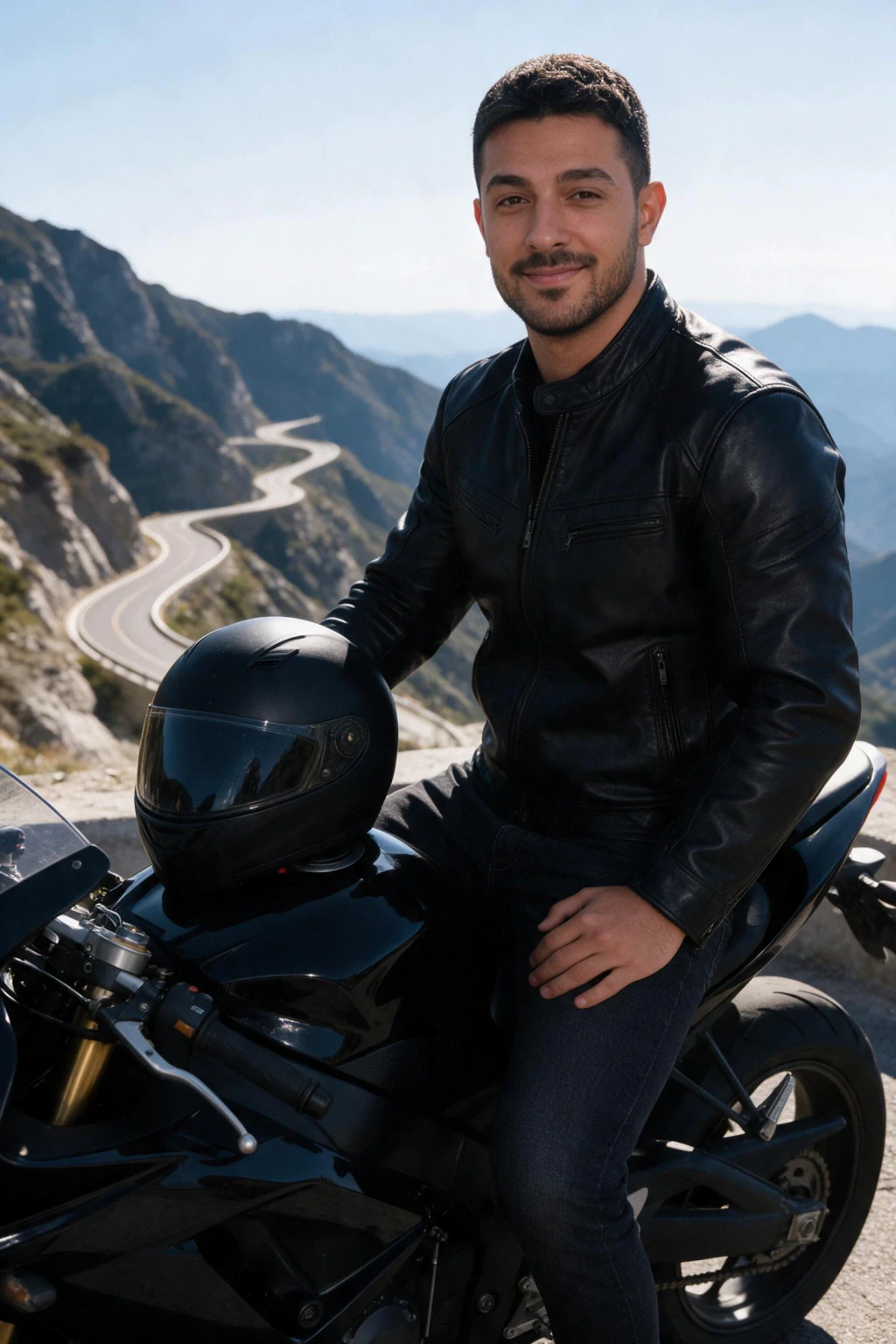
Prompt 1, sport bike: Use the face in the uploaded photo exactly and keep it fully uncovered. Sitting sideways on a parked unbadged sport motorcycle in gloss black, on its side stand with the engine off, at a mountain pass overlook with hairpin roads behind. A plain black full-face helmet resting on the fuel tank. Plain black leather jacket and dark jeans with no text or patches. No badges, no logos, no text on the tank, no license plate. Both wheels perfectly round, solid cast wheels, front wheel under the handlebars. Bright clear daylight, confident smile, knees-up shot with the face large.
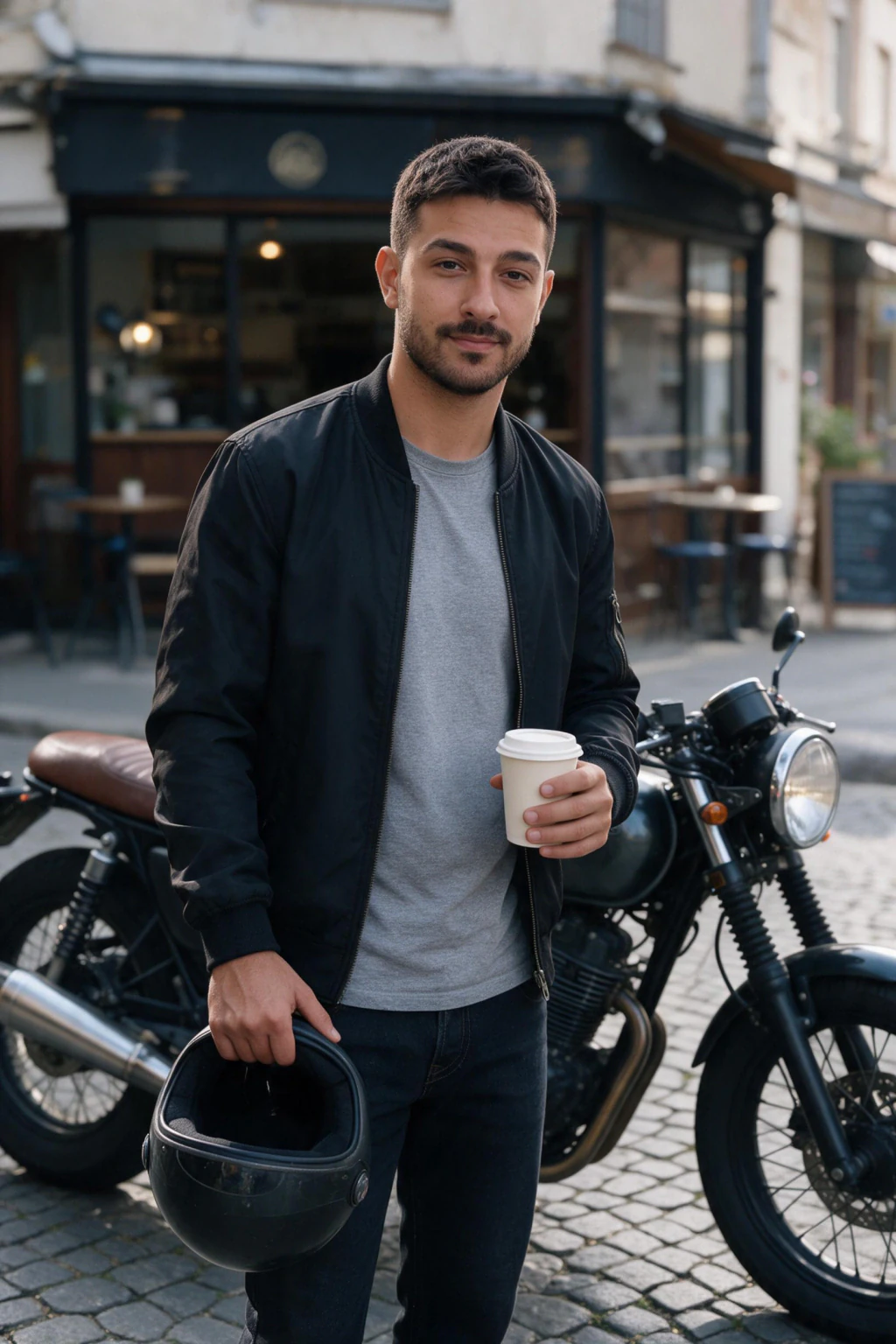
Prompt 2, cafe racer: Use the face in the uploaded photo exactly and keep it fully uncovered. Standing beside a parked unbadged vintage cafe racer with a round headlight and a plain brown leather seat, on its side stand with the engine off, outside a small street cafe on cobblestones in soft morning light. A plain open-face helmet held in one hand, a plain paper coffee cup in the other. Plain waxed jacket over a grey tee. No badges, no logos, no text on the tank, no readable signs, no license plate. Both wheels perfectly round with even wire spokes, front wheel under the handlebars. Relaxed smile, knees-up shot with the face large.
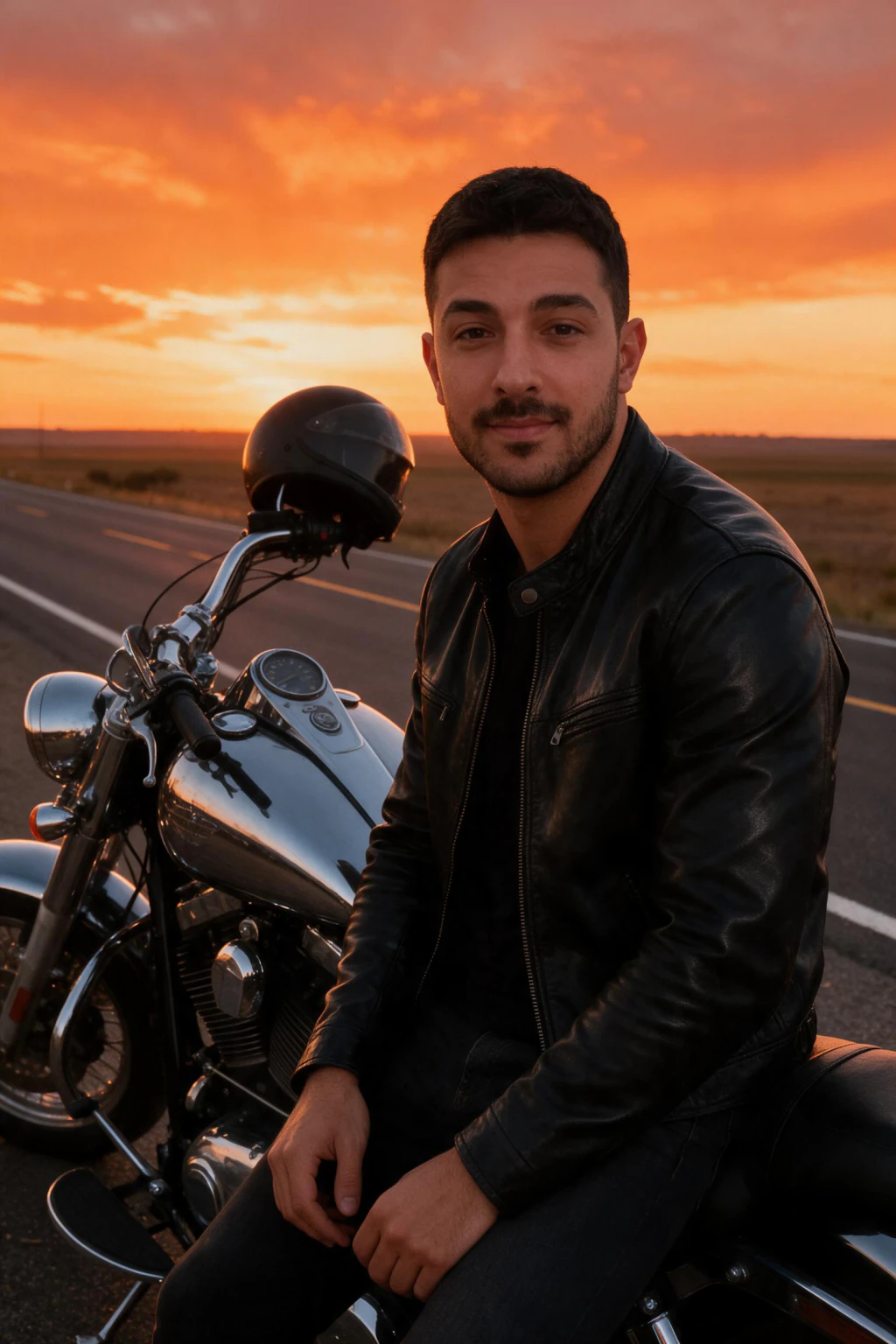
Prompt 3, cruiser at sunset: Use the face in the uploaded photo exactly and keep it fully uncovered. Standing beside a parked unbadged heavyweight cruiser with plain chrome and a plain black tank, on its side stand with the engine off, on the shoulder of an open two-lane highway at sunset, orange sky behind. A plain open-face helmet hanging from the handlebar. Plain black leather jacket, no sunglasses. No badges, no logos, no text on the tank, no license plate. Both wheels perfectly round, front wheel under the handlebars. Warm rim light, calm smile, knees-up shot with the face large.
Prompt 4, rainy night: Use the face in the uploaded photo exactly and keep it fully uncovered. Standing beside a parked unbadged naked street motorcycle on its side stand at a wet city curb at night, neon reflections on the asphalt, light rain, engine off. A plain dark full-face helmet held under one arm, visor up. Plain dark rain jacket with no text. No badges, no logos, no text on the tank, no readable signs, no license plate. Both wheels perfectly round, front wheel under the handlebars. One cool street light from the side, face sharp and dry-looking, knees-up shot with the face large.
Prompt 5, mountain road: Use the face in the uploaded photo exactly and keep it fully uncovered. Leaning against a parked unbadged adventure touring motorcycle on a gravel pull-off beside a mountain road, pine slopes and a valley behind, side stand down, engine off. A plain white helmet resting on the seat. Plain riding jacket and gloves tucked in one pocket, no text or patches. No badges, no logos, no text on the tank, no license plate. Both wheels perfectly round with chunky tires, front wheel under the handlebars. Late afternoon sun from the side, easy smile, knees-up shot with the face large.
Prompt 6, couple on the bike: Use both faces from the two uploaded photos exactly and keep them fully uncovered. Two people seated on a parked unbadged cruiser, rider in front and passenger behind with a hand on the rider's shoulder, on its side stand with the engine off at a quiet coastal road at golden hour. Two plain helmets hanging from the handlebars. Plain leather jackets, no text. No badges, no logos, no text on the tank, no license plate. Both wheels perfectly round, front wheel under the handlebars. Warm low sun, both smiling at the camera, knees-up shot with both faces large.
Which motorcycle AI photo prompt words matter, and what breaks without them?
Every prompt above carries the same seven instructions. Drop one and a specific thing goes wrong, which is why the one-line bike prompts copied from social posts rarely land.
| Prompt words | What they do | What breaks without them |
|---|---|---|
| Use the face in the uploaded photo exactly, fully uncovered | Tells the model which face matters | A smoother, younger stranger with your haircut |
| Helmet resting on the tank, held, or hanging from the bar | Keeps the helmet in frame but off your head | A closed visor or a tinted shield where your face should be |
| No badges, no logos, no text on the tank, no license plate | Keeps the bike blank | A named brand on the tank, made-up lettering, or a fake plate |
| Parked on its side stand, engine off | A still scene with a sharp face | Motion blur across the face, or a lean no parked bike could hold |
| Both wheels perfectly round, front wheel under the handlebars | Pins the two parts models get wrong most | Oval or warped wheels, and a front wheel drifting out of line |
| One named light: clear daylight, wet neon, low sun | Gives the scene a single real light source | Flat, glossy light that reads as a render |
| Knees-up shot with the face large | Gives the face enough pixels to keep | A wide shot where the face is tiny and gets redrawn |
Why does a chatbot change your face on a motorcycle?
A general image chatbot does not paste your face onto a rider. It redraws the whole frame, your face included, from its own idea of the person in your photo, so the likeness moves a little on every attempt.
Bike photos make it worse than most scenes, for three reasons.
The helmet: A full-face helmet on your head leaves the model a visor opening and two eyes, and a tinted visor leaves nothing at all. With no face to keep, it invents one.
The motion: Riding shots ask for speed, blur and a lean into a corner. Blur is permission to soften the details that make your face yours, and a leaning rider is usually shot from far away.
The framing: A bike is long, so prompts ask for a wide full-length shot. Your face ends up a few hundred pixels across, and at that size the model fills it in from averages.
A generator built for photos of you works the other way round. MakeAiPhotos starts from your selfie, keeps your features, and generates the bike, the road and the light around them, with the helmet held and the face large. Pick a look in the AI car and motorcycle photo generator and it comes back in about 2 minutes with no model training.
One limit worth knowing: those looks are single subject. For the couple shot in prompt 6 you need a chatbot with both photos attached, and you accept the drift.
What does an AI photo with a bike look like from one selfie?
These three came from one phone selfie through the MakeAiPhotos looks, which follow the same rules as the prompts above: a parked unbadged bike, a helmet off the head, and a face large enough to stay put.
Why do motorcycles break in AI images, and which words keep them believable?
A motorcycle is a machine made of paired, connected parts, and image models draw by pattern, not by mechanics. In a small, informal November 2024 test, ChatGPT with DALL-E 3 kept getting a bicycle's parts wrong across three attempts, even after being told the front wheel sits below the handlebars and the chain connects to the rear wheel. That test used a bicycle, not a motorcycle, but a motorcycle has the same paired parts and more of them.
Wheels: Seen from an angle, each wheel is an ellipse, and the two ellipses have to agree with each other. Models often draw them at different angles, which reads as a bent wheel. Say both wheels perfectly round, and on a sport bike ask for solid cast wheels, which give the model fewer lines to get wrong than wire spokes.
Forks and steering: The front wheel sits between two fork tubes, straight under the handlebars. When the model loses that line, the wheel drifts sideways and the bike looks unrideable. Saying front wheel under the handlebars, the same correction the bicycle testers had to spell out, names that line for the model.
Chain: A chain drive runs on one side of the bike only, from the small front sprocket to the rear wheel. Models add a second chain, end it in mid-air, or loop it through the swingarm. Shooting from the side that hides it, or a cruiser with a covered drive, removes the problem.
Mirrors and exhaust: A bike has two mirrors that match, and its exhaust leaves from one place. Extra mirrors and a third silencer are common. Fewer visible parts means fewer chances to get one wrong, which is why a three-quarter front angle usually beats a straight side view.
Hands on the bars: Two hands wrapped around grips means ten fingers the model has to count and bend correctly, next to levers it also has to draw. One hand on the tank and one holding the helmet is easier on the model and looks more relaxed.
Then the helmet itself. It is the one prop that works against you. Riders wear one for good reason, so the photos here show a parked bike with the helmet held, never a moving bike and never a ride without one.
Why does a helmet on your head erase your likeness?
Likeness lives in the jaw, the cheekbones, the nose and the mouth. A full-face helmet covers all four, and an open-face helmet's straps and cheek pads still reshape the jaw and push the cheeks forward.
What the model has left is the strip of face behind the visor opening, and eyes alone are not enough for it to keep you. It fills the rest with a generic face that happens to share your eye color.
Visor down makes it worse again. A tinted or mirrored visor shows a reflection instead of a face, so there is nothing of you in the frame at all.
The fix is framing, not wording. Put the helmet on the tank, in your hand or on the bar, face the camera, and keep the shot knees-up. Your face then fills enough of the frame to be the thing the model protects.
For more on the selfie side of that, how to make AI photos look realistic covers skin, light and the checks worth running before you post. The same rules carry over to cars in the AI car photo prompts post.
What is in the car and motorcycle pack?
The AI car and motorcycle photo page has 10 ready-made looks, 7 cars and 3 motorcycles, so there is nothing to paste. The three bikes are the sport bike at a mountain pass, the cafe racer outside a street cafe, and the cruiser on a highway at sunset.
The 7 car looks are a supercar at night, a 4x4 in the desert, a JDM garage, a muscle car, a pit lane, a classic convertible and a driver-seat selfie. Every vehicle is unbadged, every helmet is off the head, and every shot is framed with the face large.
If you want motion without a bike, the AI extreme sports photos pack covers the action side from the same kind of selfie.
Frequently Asked Questions
- Can Gemini or ChatGPT make a photo of me on a motorcycle?
- Yes, if you attach a clear selfie and use a detailed prompt like the six above. Expect the face to drift between attempts, because a general chatbot redraws it each time, and keep the helmet off your head. If your face keeps changing, a one-selfie generator such as MakeAiPhotos keeps your features, about 2 minutes per photo.
- What is the best biker AI photo prompt?
- The best one names the bike, the helmet, the light and the framing: a parked unbadged bike with no logos, text or plate, a helmet held or resting on the tank, both wheels perfectly round, one named light source, a knees-up shot with the face large, and an instruction to keep the exact face from your photo.
- Why doesn't my AI bike photo look like me?
- The chatbot redraws your whole face instead of keeping it, and bike prompts make that worse: a helmet covers most of the face, motion blur softens it, and wide shots shrink it. Use a sharp front-facing selfie, keep the helmet off your head, frame the shot knees-up, and ask it to keep your exact face.
- Why does the AI put a brand logo on my motorcycle?
- Because real motorcycles almost always carry a maker's badge on the tank, so image models tend to draw one in or invent lettering where it would sit. Say no badges, no logos, no text on the tank and no license plate. The six prompts above are written that way.
- Why are the wheels bent in my AI motorcycle photo?
- Because the model draws each wheel as a separate ellipse and the two often disagree, which reads as a bent or oval wheel. Ask for both wheels perfectly round and the front wheel under the handlebars, pick a three-quarter front angle, and on a sport bike ask for solid cast wheels instead of wire spokes.
- How do I make an AI photo with a bike without a chatbot?
- Upload one clear selfie to MakeAiPhotos, pick the sport bike, cafe racer or cruiser look, and the photo comes back in about 2 minutes with your face kept. There is no model training. $14.99 covers about 15 photos, with a 14-day money-back guarantee, so one selfie can become all three bikes.